GEARÓID Ó TUATHAIGH 2023
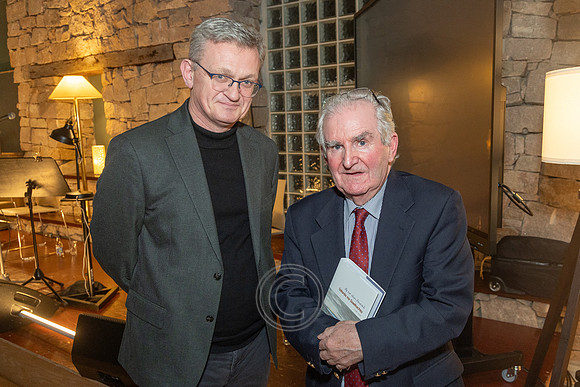
Professor Breandán Mac Suibhne, left, historian at the University of Galway, and Gearóid Ó Tuathaigh, Professor Emeritus of History at the University of Galway, at the launch of the book, "AG CUR CHUN FÓNAIMH Údarás na Gaeltachta ó 1980 i leith" wrItten by Professor Ó Tuathaigh and edited by Breandán Mac Suibhne. The book, launched at Stiúideo Cuan, in An Spidéal last Thursday by University of Galway President Ciarán Ó hÓgartaigh, is an account of the organisation tasked with the welfare of the Gaeltacht region and its community since 1980. It is published by Cló Iar-Chonnacht. Pic: Seán Ó Mainnín
BACKGROUND INFO
Since the inception of the state, there has beenan ongoing discourse concerning thepreservation and enhancement of the Gaeltacht,and the concept of assigning this responsibilityto a specific organisation. This laudable intention lapsed for a considerable period until the establishment of Gaeltarra Éireann in 1958. Its primary objective was to foster the development of both traditional rural industriesand new sectors within the Gaeltacht. As time advanced, Gaeltarra's purview broadened. However, towards the close of the sixties,community leaders in the Gaeltacht advocatedfor a more robust and inclusive institution, onethat integrated a strong democratic element. In answer to this demand, Údarás na Gaeltachtaemerged as an exceptional initiative aimed atrealising the state's significant social andcultural objectives. AG CUR CHUN FÓNAIMH Údarás na Gaeltachta ó 1980 i leith GEARÓID Ó TUATHAIGH, Professor Emeritus ofHistory at the University of Galway, is known forhis extensive publications delving into thehistorical evolution of language in Ireland andthe circumstances within the Gaeltacht. He co-edited 'Pobal na Gaeltachta a Scéal agus a Dhán'(2000). BRENDÁN MAC SUIBHNE, historian at theUniversity of Galway, also serves as the studentdirector at Acadamh na hOllscolaíochta Gaeilge.He is the author of 'The End of Outrage' (2017)and, alongside David Dickson, collaborated as aneditor on Hugh Donan's work, 'The Outer Edge ofUlster' (2000, 2001). www.cic.ie Publisher: Cló Iar-Chonnacht
Since the inception of the state, there has beenan ongoing discourse concerning thepreservation and enhancement of the Gaeltacht,and the concept of assigning this responsibilityto a specific organisation. This laudable intention lapsed for a considerable period until the establishment of Gaeltarra Éireann in 1958. Its primary objective was to foster the development of both traditional rural industriesand new sectors within the Gaeltacht. As time advanced, Gaeltarra's purview broadened. However, towards the close of the sixties,community leaders in the Gaeltacht advocatedfor a more robust and inclusive institution, onethat integrated a strong democratic element. In answer to this demand, Údarás na Gaeltachtaemerged as an exceptional initiative aimed atrealising the state's significant social andcultural objectives. AG CUR CHUN FÓNAIMH Údarás na Gaeltachta ó 1980 i leith GEARÓID Ó TUATHAIGH, Professor Emeritus ofHistory at the University of Galway, is known forhis extensive publications delving into thehistorical evolution of language in Ireland andthe circumstances within the Gaeltacht. He co-edited 'Pobal na Gaeltachta a Scéal agus a Dhán'(2000). BRENDÁN MAC SUIBHNE, historian at theUniversity of Galway, also serves as the studentdirector at Acadamh na hOllscolaíochta Gaeilge.He is the author of 'The End of Outrage' (2017)and, alongside David Dickson, collaborated as aneditor on Hugh Donan's work, 'The Outer Edge ofUlster' (2000, 2001). www.cic.ie Publisher: Cló Iar-Chonnacht
Since the inception of the state, there has beenan ongoing discourse concerning thepreservation and enhancement of the Gaeltacht,and the concept of assigning this responsibilityto a specific organisation. This laudable intention lapsed for a considerable period until the establishment of Gaeltarra Éireann in 1958. Its primary objective was to foster the development of both traditional rural industriesand new sectors within the Gaeltacht. As time advanced, Gaeltarra's purview broadened. However, towards the close of the sixties,community leaders in the Gaeltacht advocatedfor a more robust and inclusive institution, onethat integrated a strong democratic element. In answer to this demand, Údarás na Gaeltachtaemerged as an exceptional initiative aimed atrealising the state's significant social andcultural objectives. AG CUR CHUN FÓNAIMH Údarás na Gaeltachta ó 1980 i leith GEARÓID Ó TUATHAIGH, Professor Emeritus ofHistory at the University of Galway, is known forhis extensive publications delving into thehistorical evolution of language in Ireland andthe circumstances within the Gaeltacht. He co-edited 'Pobal na Gaeltachta a Scéal agus a Dhán'(2000). BRENDÁN MAC SUIBHNE, historian at theUniversity of Galway, also serves as the studentdirector at Acadamh na hOllscolaíochta Gaeilge.He is the author of 'The End of Outrage' (2017)and, alongside David Dickson, collaborated as aneditor on Hugh Donan's work, 'The Outer Edge ofUlster' (2000, 2001). www.cic.ie Publisher: Cló Iar-Chonnacht
Since the inception of the state, there has beenan ongoing discourse concerning thepreservation and enhancement of the Gaeltacht,and the concept of assigning this responsibilityto a specific organisation. This laudable intention lapsed for a considerable period until the establishment of Gaeltarra Éireann in 1958. Its primary objective was to foster the development of both traditional rural industriesand new sectors within the Gaeltacht. As time advanced, Gaeltarra's purview broadened. However, towards the close of the sixties,community leaders in the Gaeltacht advocatedfor a more robust and inclusive institution, onethat integrated a strong democratic element. In answer to this demand, Údarás na Gaeltachtaemerged as an exceptional initiative aimed atrealising the state's significant social andcultural objectives. AG CUR CHUN FÓNAIMH Údarás na Gaeltachta ó 1980 i leith GEARÓID Ó TUATHAIGH, Professor Emeritus ofHistory at the University of Galway, is known forhis extensive publications delving into thehistorical evolution of language in Ireland andthe circumstances within the Gaeltacht. He co-edited 'Pobal na Gaeltachta a Scéal agus a Dhán'(2000). BRENDÁN MAC SUIBHNE, historian at theUniversity of Galway, also serves as the studentdirector at Acadamh na hOllscolaíochta Gaeilge.He is the author of 'The End of Outrage' (2017)and, alongside David Dickson, collaborated as aneditor on Hugh Donan's work, 'The Outer Edge ofUlster' (2000, 2001). www.cic.ie Publisher: Cló Iar-Chonnacht